With more than 28,000 unfilled truck driver positions across Australia in early 2026, the demand for skilled operators has reached a critical level. You might feel a bit of pressure when deciding which heavy vehicle driving academy to trust with your training, especially with the confusion often surrounding gearbox conditions and national licensing standards. It is common to worry about whether you should choose an automatic, synchromesh, or an unrestricted Road Ranger licence, or if you are even looking at the right regulations across Australia. Right Way Transport Training understands these concerns.
We understand that you want to pass your assessment on the first go and start earning as soon as possible. This guide, brought to you by Right Way Transport Training, is designed to help you master the requirements for HR, HC, and MC licences by providing expert guidance tailored to national standards. We will break down the differences between gearbox codes, explain the 2026 licensing framework, and show you how to build the confidence needed to operate heavy vehicles safely and professionally on our roads.
Key Takeaways
- Understand why choosing a registered heavy vehicle driving academy ensures your training meets strict WA Department of Transport compliance and safety standards.
- Learn the specific differences between HR, HC, and MC licences to determine which vehicle class aligns with your career path in Western Australia.
- Clarify how your choice of gearbox-Automatic, Synchromesh, or Road Ranger-affects your licence conditions and long-term employment opportunities.
- Discover exactly what to expect during a WA DoT practical assessment, including the critical pre-start checks and vehicle inspections.
- Gain insights into the essential industry skills, such as load restraint and fatigue management, that help you transition from a student to a professional driver.
What Defines a Professional Heavy Vehicle Driving Academy?
Choosing the right place to train for your truck licence is a decision that affects your safety and your career prospects. A professional heavy vehicle driving academy is more than just a business that provides access to a truck. It is a structured environment designed to turn students into competent, safety-conscious operators who are ready for the demands of the Australian transport industry. In Western Australia, this means adhering to the strict standards set by the Department of Transport (DoT) WA while providing a learning atmosphere that balances technical skill with practical, real-world wisdom.
The best academies don’t just teach you how to pass a test. They prepare you for a long-term career. This involves a commitment to high-quality equipment, experienced staff, and a curriculum that reflects the current state of the industry in 2026. Whether you are looking to obtain a Commercial driver’s licence for the first time or you are upgrading an existing qualification, the quality of your initial instruction sets the foundation for your future on the road.
The Role of an RTO in Western Australia
In Western Australia, a reputable heavy vehicle driving academy must operate as a Registered Training Organisation (RTO). This status is not just a badge; it’s a guarantee of compliance. RTOs are regulated at a national level to ensure that the training they deliver is consistent, transparent, and high-quality. When you train with an RTO, you know that your instructors are following a curriculum that meets the specific units of competency required for HR, HC, or MC licences. This accreditation is vital because it ensures your qualifications are recognised by employers across the country, not just within Perth.
Academy vs. Independent Instructors
While you might find independent instructors offering “truck driving lessons,” there is a significant difference in the value provided by a structured academy environment. Academies typically offer a more comprehensive experience that prioritises professional standards over quick fixes.
- Modern Fleet Access: Academies invest in a diverse range of HR, HC, and MC vehicles. Training on modern equipment ensures you’re familiar with the technology and safety features found in today’s transport yards.
- Methodical Learning: A structured academy uses a purposeful curriculum. This allows you to build your skills in a logical sequence, moving from basic vehicle control to complex manoeuvres with confidence.
- Industry-Standard Facilities: Having a dedicated space for pre-start checks and reversing practice allows you to learn without the distractions of public traffic.
The trainers at a professional academy are usually seasoned industry veterans. They act as mentors, sharing insights that only come from years of operating heavy vehicles in various conditions. They don’t just tell you what to do; they explain the “why” behind every action. This depth of knowledge is what helps you develop the defensive driving habits and load-handling skills necessary to stay safe and employable in the competitive WA transport sector.
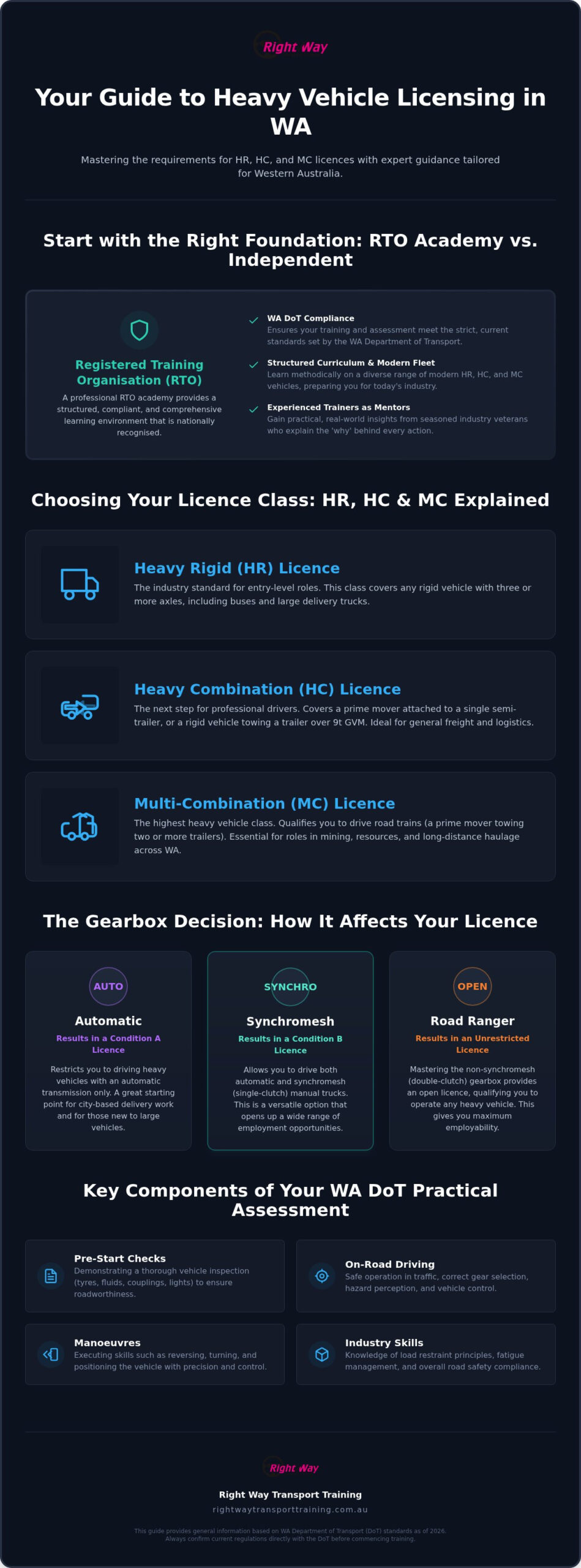
Choosing Your Class: HR, HC, and MC Licences Explained
Selecting the right licence class is the first major step in your transport career. While the process of getting a heavy vehicle licence follows similar principles across the country, the Western Australian Department of Transport (DoT) has specific eligibility criteria that you must meet before booking an assessment. A professional heavy vehicle driving academy will help you identify which class suits your current experience and your long-term job goals, ensuring you don’t spend time on a qualification that doesn’t fit your needs.
In WA, the progression is usually linear. You start with your car licence, move to a rigid vehicle, and eventually progress to combinations. Each step requires a dedicated Practical Driving Assessment (PDA) conducted by a DoT examiner or an authorised provider. Understanding these categories helps you plan your training budget and timeline effectively. It’s not just about the size of the truck; it’s about the specific type of work you intend to do in the Perth region or across the Pilbara.
Heavy Rigid (HR) Licence Pathways
The HR licence is the industry standard for those entering the transport sector. It covers rigid vehicles with three or more axles and a Gross Vehicle Mass (GVM) greater than 8 tonnes. This is a significant step up from a Medium Rigid (MR) licence, which is restricted to two axles. Most local delivery, waste management, and construction roles in Perth require at least an HR qualification. To be eligible for an HR licence in WA, you must have held your C-class (car) licence for at least two years. If you already hold an MR licence, you only need to have held it for one year before upgrading. This waiting period ensures you’ve developed the spatial awareness and defensive driving habits necessary for larger vehicles.
Advancing to HC and MC Classes
If your goal is to operate semi-trailers or road trains, you’ll need to look at Heavy Combination (HC) or Multi Combination (MC) training. The HC licence allows you to drive a prime mover attached to a single semi-trailer or a rigid vehicle towing a trailer with a GVM greater than 9 tonnes. The primary challenge here is mastering the articulation point; reversing a semi-trailer requires a completely different mental map than driving a rigid truck. Our trainers focus heavily on these reversing manoeuvres to ensure you feel confident during the DoT assessment.
Multi Combination (MC) is the highest level of heavy vehicle licensing. It covers B-doubles and road trains, which are essential for the mining and long-haul sectors. To qualify for an MC licence in WA, you must have held your HR or HC licence for at least one year. Upgrading to these higher classes makes you a much more versatile asset to employers, often leading to more consistent work and better pay. If you’re ready to take that next step, the instructors at Right Way Transport Training can provide the practical, hands-on experience needed to handle these massive combinations safely.
The Gearbox Debate: Automatic, Synchromesh, or Road Ranger?
The choice of gearbox is one of the most significant decisions you will make at a heavy vehicle driving academy. In Western Australia, the vehicle you use for your practical assessment determines the conditions placed on your licence. While modern fleets are increasingly moving toward automatic transmissions, the ability to operate a manual gearbox remains a highly valued skill that can separate you from other applicants in the job market. You should choose your training vehicle based on the specific industry you plan to enter.
If you choose the Automatic (HR-A) pathway, you will find the learning curve is much shallower. It allows you to focus entirely on vehicle positioning and road rules without worrying about gear selection. However, you will be restricted to driving automatic vehicles only. The Synchromesh (HR-B) option is similar to driving a manual car, where the gearbox assists with gear synchronisation. This grants you the ability to drive both synchromesh and automatic trucks, which is often sufficient for local Perth delivery roles where stop-start traffic is common.
Mastering the Road Ranger (Constant Mesh)
For those seeking a career in heavy haulage or long-distance transport, the Non-Synchromesh or Road Ranger gearbox is the essential choice. Passing your assessment in this vehicle gives you an Open licence, meaning you can drive any heavy vehicle gearbox. This requires the technique of double-clutching; engaging the clutch once to neutral and again to the next gear while perfectly matching engine revolutions. It is a technical skill. It requires patience and expert mentoring from a seasoned trainer who understands the mechanics of the driveline. The Australian Trucking Association emphasises that while technology is changing, the fundamental skills of gear and speed management remain core to professional driving standards across the country.
Understanding Licence Conditions in WA
In Western Australia, if you pass your test in a synchromesh vehicle, the Department of Transport will apply a Condition B to your licence. This effectively prevents you from operating a non-synchromesh vehicle. Removing this restriction later requires you to undergo a new practical assessment in a Road Ranger truck, which means more time and expense. It is usually more efficient to learn the Road Ranger from the start if you have the aptitude for it.
When deciding, consider your specific job goals. If you are aiming for a high-paying role in the WA mining sector, an Open licence is often a non-negotiable requirement. Many mine-site vehicles and heavy-duty prime movers still utilise constant mesh gearboxes for their durability under extreme loads. Choosing a heavy vehicle driving academy that specialises in Road Ranger training ensures you aren’t limited by your licence conditions when a great opportunity arises in the Pilbara or Goldfields.
Preparing for the Department of Transport (DoT) Practical Assessment
The Practical Driving Assessment (PDA) is the final hurdle in obtaining your licence. In Western Australia, this assessment is conducted by Department of Transport examiners or authorised providers who follow a strict set of criteria. Entering this environment can be stressful, but a quality heavy vehicle driving academy ensures you are prepared for every stage of the process. The assessment is generally divided into three main components: the pre-start check, the off-road manoeuvres, and the on-road driving session. Each part must be completed successfully to demonstrate that you are a safe and competent operator.
Your assessment begins with the pre-start check. The examiner looks for your ability to identify potential safety issues before the engine even starts. This includes checking tyres, lights, and fluid levels, as well as ensuring the vehicle is roadworthy. For HC and MC candidates, this stage also involves demonstrating the correct coupling and uncoupling procedures. Failing to perform these checks correctly can end your assessment before you leave the yard, which is why we place such a high emphasis on these technical routines during your training.
The Assessment Criteria
DoT assessors use a specific “system of vehicle control” to evaluate your driving. At a professional heavy vehicle driving academy, this system is taught as a methodical approach to approaching hazards, turning, and managing intersections. It involves a sequence of mirror checks, signalling, gear selection, and braking. Common mistakes that lead to an immediate fail include mounting a kerb during a turn, exceeding the speed limit, or failing to come to a complete stop at a stop sign. Staying calm is essential. Our trainers teach you to focus on the routine of the system, which helps manage pressure and ensures you demonstrate consistent competence throughout the drive.
Mock Assessments and Readiness
We believe that your first time under assessment conditions shouldn’t be with the DoT examiner. This is why we conduct mock assessments as part of our curriculum. These sessions mirror the actual test environment, allowing your instructor to identify any lingering habits that might cause issues. We also ensure all your paperwork, such as your learner’s permit and any required eligibility documents, is organised and ready. Our goal is to ensure you are road-ready, not just test-ready. When you feel confident in your skills, the assessment becomes a simple demonstration of what you already know. If you are ready to start your journey, you can book your assessment through Right Way Transport Training to ensure you meet all WA DoT standards.
Beyond the Licence: Launching Your Career in Transport
Earning your heavy vehicle qualification is a significant achievement, but it is actually the starting point of your professional journey. The Australian transport industry contributes approximately $40 billion annually to the national GDP; it relies on skilled drivers to keep the economy moving. By early 2026, there were more than 28,000 unfilled truck driver positions across the country. This shortage means that a graduate from a reputable heavy vehicle driving academy is entering a market with high demand and diverse opportunities. However, employers in Western Australia look for more than just a piece of plastic in your wallet. They want to see a commitment to safety, professional conduct, and a solid understanding of operational practicalities.
Success in this field requires a transition from “learning to drive” to “learning to operate.” This involves developing defensive driving habits that account for the massive weight and stopping distances of heavy vehicles. Professionalism also means understanding your role as a representative of your company while on the road. Whether you are delivering local freight in Perth or hauling equipment to a mine site in the Pilbara, your attitude toward safety and vehicle care will define your reputation in the industry.
Essential Safety and Professionalism
Safety is the highest priority for any transport company. Fleet managers value drivers who demonstrate a safety-first attitude before they even climb into the cab. This starts with performing thorough daily safety checks and maintaining the vehicle to prevent mechanical failures. You must also have a firm grasp of load restraint principles and fatigue management. While the National Heavy Vehicle Regulator (NHVR) manages many aspects of transport nationally, you must stay informed about specific Western Australian Department of Transport regulations. Managing your work hours and ensuring your load is secure are not just legal requirements; they are the hallmarks of a professional operator who protects themselves and other road users.
Finding Work in Western Australia
Western Australia offers a unique landscape for heavy vehicle operators. The mining, logistics, and civil construction sectors are constantly seeking qualified HR, HC, and MC drivers. If you are a new starter with an HR licence, look for roles in local distribution or waste management to build your initial hours. Many companies are willing to mentor new drivers who show a willingness to learn and a reliable work ethic. As you gain experience, you can look toward upgrading your licence to handle larger combinations or specialised haulage. The average age of an Australian truck driver is 47 years old, which means the industry is actively looking for the next generation of drivers to fill the gap. If you are ready to make your move, Enquire about our HR, HC, or MC training programs today and get the practical skills you need to succeed.
Take the Next Step Toward Your Professional Driving Career
Obtaining your heavy vehicle licence is a practical investment in your long-term vocational future. We have explored how choosing a professional heavy vehicle driving academy helps you navigate the specific WA Department of Transport requirements and select the right gearbox for your specific career goals. Whether you are aiming for an unrestricted Open licence or a specialised HR qualification, receiving the right instruction ensures you are prepared for the realities of the road, not just the assessment day.
Right Way Transport Training provides the expert mentorship you need to succeed. Our team consists of experienced industry-veteran trainers who specialise in HR, HC, and MC licences. We ensure every student receives training that is fully compliant with WA Department of Transport standards, focusing on real-world safety and technical competence. With the current driver shortage across Western Australia, there has never been a better time to upgrade your skills and enter the transport sector with confidence.
Take the first step toward a stable and rewarding career today. Start your heavy vehicle training with Right Way Transport Training today and join the ranks of Perth’s most capable heavy vehicle operators.
Frequently Asked Questions
How long does it take to get an HR licence in WA?
Obtaining an HR licence in WA typically takes between one and two days of intensive training and assessment. Most students choose a structured course at a professional heavy vehicle driving academy that includes several hours of practical instruction followed by the Department of Transport (DoT) assessment. Your previous experience with manual gearboxes or larger vehicles can influence how many hours of training you need to feel confident and road-ready.
Can I learn to drive a Road Ranger if I have only driven an automatic car?
You can certainly learn to drive a Road Ranger truck even if you have only driven automatic cars, but the learning curve is significantly steeper. It requires mastering the double-clutching technique to match engine revolutions with gear speed. Most instructors recommend allowing extra training hours to build the muscle memory needed for this specific gearbox before you attempt the practical assessment with the Department of Transport.
What is the difference between a Synchromesh and a Non-Synchromesh gearbox?
A synchromesh gearbox functions similarly to a manual car, where internal components synchronise the gear speeds for you during a shift. In contrast, a non-synchromesh or Road Ranger gearbox requires the driver to manually match the engine speed to the road speed using a double-clutching method. Passing in a synchromesh vehicle results in a Condition B restriction, while the Road Ranger provides an unrestricted Open licence.
Do I need to do a theory test before my practical assessment in WA?
Yes, you must successfully complete the Heavy Vehicle Theory Test at a Department of Transport WA centre before you can sit your practical assessment. This test ensures you understand the specific road rules and safety requirements for operating larger vehicles. It is best to complete this early in your training process so your learner’s permit is ready for your practical driving sessions in the truck.
How much does heavy vehicle training cost in Perth?
The cost of heavy vehicle training in Perth varies depending on the licence class, the type of gearbox you choose, and the number of training hours required. Generally, fees cover the hire of the vehicle and the instructor’s time. You must also account for WA Department of Transport fees, such as the standard heavy vehicle licence administration recording fee of $9.70, which is part of the current 2026-27 schedule.
What happens if I fail my Department of Transport assessment?
If you do not pass your Department of Transport practical assessment, you are permitted to re-sit the test after a required waiting period. You will need to book a new assessment slot and pay the associated DoT and vehicle hire fees again. Most students choose to take additional remedial training with their heavy vehicle driving academy to address the specific areas identified by the assessor before their next attempt.
Can I upgrade from an HR to an MC licence directly?
You can upgrade from an HR to an MC licence directly in Western Australia, provided you have held your HR or HC licence for at least one year. This pathway allows you to skip the HC stage if your career goal is to operate road trains or B-doubles. However, the jump in vehicle complexity is significant, so thorough training on combination vehicle dynamics and reversing is essential for a successful transition.
Is a medical check required for a heavy vehicle licence in WA?
A medical assessment is a mandatory requirement for all heavy vehicle drivers in Western Australia to ensure you meet the national Assessing Fitness to Drive standards. You will need to complete a Commercial Vehicle Driver Medical Examination with your GP. The Department of Transport WA requires this documentation to confirm you are physically capable of safely operating heavy vehicles on public roads before your licence can be issued.