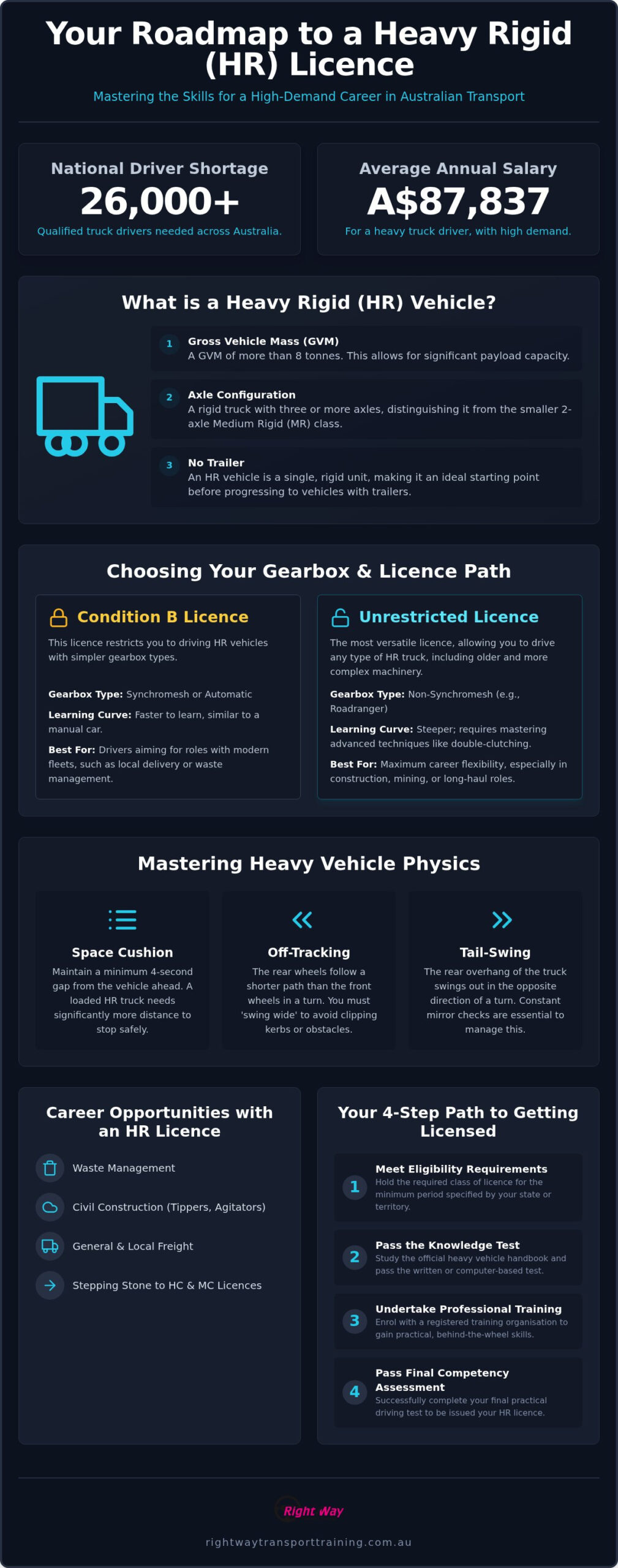
Did you know that Australia is currently facing a shortage of over 26,000 truck drivers? With the average heavy truck driver earning approximately A$87,837 per year, there has never been a better time to transition into the transport industry. We understand that the first step feels daunting. You might be worried about the sheer size of the vehicle or feel confused by the difference between a Synchromesh and a Roadranger gearbox. It’s perfectly normal to feel a bit overwhelmed when you decide to learn to drive heavy rigid truck units for the first time.
This beginner’s guide is designed to replace that uncertainty with professional confidence. We’ll provide a clear roadmap to your licence, explaining the legal eligibility requirements and the specific technical skills required to master these powerful machines. You will discover how to choose the right gearbox for your goals and gain a thorough understanding of the training process. By the end of this article, you’ll feel ready to start your professional journey with a steady, informed mindset. Let’s get your transport career off the ground.
Key Takeaways
- Understand exactly what qualifies as a Heavy Rigid (HR) vehicle and why this licence is a versatile asset for careers in mining, construction, and local delivery.
- Master the physics of heavy vehicles, including how to manage your space cushion and account for tail-swing during tight turns.
- Discover the differences between Synchromesh and Roadranger gearboxes so you can choose the best path when you learn to drive heavy rigid truck units for your career.
- Learn the clear, step-by-step process to get licensed, from meeting Australian eligibility requirements to passing your state’s knowledge test.
- Gain the confidence to move beyond just passing a test by seeking mentorship-style training that prepares you for real-world industry demands.
What is a Heavy Rigid (HR) Truck and Why Learn to Drive One?
An HR truck is a powerhouse of the Australian road network, serving as the backbone for many local industries. Technically, a Heavy Rigid vehicle is defined as any truck with a Gross Vehicle Mass (GVM) of more than 8 tonnes and at least three axles. This axle configuration is the main factor that separates the HR class from the smaller Medium Rigid (MR) class, which is limited to just two axles. When you decide to learn to drive heavy rigid truck units, you are stepping into a vehicle that offers significantly more payload and power than smaller commercial alternatives.
The HR licence is often considered the “sweet spot” for entry-level transport roles. It allows you to operate heavy machinery without the added complexity of a trailer, making it an accessible yet highly rewarding career move. Whether you are aiming for a role in local freight or looking to join a civil construction team, this qualification provides the foundational skills needed to operate safely in high-pressure environments.
Understanding the HR Licence Class
In plain English, the HR class covers a wide variety of vehicles you see on the road every day. This includes large pantechs used for furniture removals, concrete agitating trucks, and heavy tippers used on building sites. It’s essentially the Australian equivalent of a Commercial driver’s license (CDL), signifying that you have met rigorous national standards for safety and vehicle control.
One critical distinction you’ll encounter is between an “Unrestricted” licence and a “Condition B” licence. A Condition B licence limits you to driving trucks with automatic or synchromesh gearboxes. An Unrestricted licence is earned by training on a non-synchromesh (Roadranger) gearbox, which requires a higher level of technical skill. Choosing the right path depends on your career goals, but both options open doors to professional driving roles across the country.
Career Opportunities for HR Drivers
The demand for qualified drivers in Australia has never been higher. With a current national shortage of over 26,000 truck drivers, employers are actively seeking individuals who possess the right qualifications and a professional attitude. Holding an HR licence makes you a valuable asset in several key sectors:
- Waste Management: Operating refuse collection vehicles in urban and regional areas.
- Civil Construction: Driving heavy tippers and agitators for major infrastructure projects.
- General Freight: Managing local deliveries for retail and industrial suppliers.
Beyond immediate employment, the HR licence serves as a vital stepping stone. You cannot jump straight into the biggest rigs on the road. Most drivers use their HR experience as a prerequisite before upgrading to Heavy Combination (HC) or Multi Combination (MC) licences. By starting here, you’re not just getting a job; you’re building a long-term career in a vital industry.
Essential Skills: Learning to Handle Heavy Vehicle Physics
Stepping into the cab of an HR truck for the first time is a significant shift from driving a standard car. You are no longer just steering a vehicle; you are managing a massive amount of momentum and weight. When you learn to drive heavy rigid truck vehicles, the first thing you must respect is the ‘space cushion’. Because these trucks can weigh over 15 tonnes when loaded, your stopping distance is much longer than you’d expect. Maintaining a minimum four-second gap between you and the vehicle ahead isn’t just a suggestion; it’s a professional necessity for safety.
Spatial awareness goes beyond just looking forward. You have to account for off-tracking and tail-swing. Off-tracking occurs when the rear wheels follow a shorter path than the front wheels during a turn. If you don’t ‘swing wide’ enough, those rear tyres will climb the kerb or clip a parked car. Conversely, tail-swing happens when the back of the truck swings out in the opposite direction of your turn. Mastering these geometric challenges is what separates a novice from a professional operator.
Mastering Spatial Awareness
Mirrors are your best friends in a heavy rigid vehicle. You should be checking them every few seconds to monitor the entire length of your truck. This is especially vital when reversing into tight loading docks, where a few centimetres can make the difference between a successful delivery and a costly insurance claim. Professional drivers don’t just look at the car in front; they look hundreds of metres down the road to anticipate traffic changes before they happen. If you’re ready to start this journey, reviewing the official Step-by-Step Path to Obtaining Your HR Licence is a great way to prepare for the technical standards required.
The Mechanics of Heavy Braking
The braking system in an HR truck is fundamentally different from a car’s hydraulic setup. Most heavy vehicles use air brakes, which rely on compressed air to apply the pads. This system has a slight ‘lag’ time, meaning the brakes don’t engage the instant you touch the pedal. You also have auxiliary systems like exhaust brakes to help manage your speed on long descents without overheating your primary brakes. Developing a precise ‘brake feel’ is essential because it allows you to apply smooth, consistent pressure that keeps the load stable and prevents wheels from locking up. If you’re looking for hands-on guidance to master these controls, the mentors at Right Way Transport Training can help you build these skills through practical, one-on-one coaching.
Finally, you must consider how weight distribution affects handling. A truck that is ‘top-heavy’ will lean significantly more in corners, increasing the risk of a rollover. Ensuring your load is secured and centred is just as important as the way you handle the steering wheel. Understanding these physics-based skills ensures you’re not just passing a test, but becoming a truly competent driver.
Synchromesh vs. Roadranger: Choosing Your Gearbox Training
When you decide to learn to drive heavy rigid truck units, one of the most important decisions you’ll face is which gearbox to master. Unlike modern passenger cars that are almost exclusively automatic, the heavy vehicle industry still relies heavily on manual transmissions for durability and control. The choice you make during your training will dictate which vehicles you can legally operate throughout your career.
The Synchromesh gearbox is the more approachable option for many beginners. It functions very similarly to a manual car, where internal synchronisers match the speed of the gears for you. This makes it faster to learn and significantly less stressful during the initial stages of your training. However, passing your assessment in a Synchromesh truck results in a ‘Condition B’ restriction on your licence. This means you are legally prohibited from driving non-synchromesh vehicles, which can limit your options in certain sectors of the transport industry.
In contrast, the Roadranger, or constant mesh gearbox, is the long-standing industry standard for heavy-duty applications. It requires a specific technique called “double-clutching” to match engine revolutions with road speed. It is a challenging skill to acquire, but it is highly valued by employers. An unrestricted licence earned on a Roadranger proves you have a high level of technical road craft and gives you the freedom to drive any HR vehicle in Australia.
The Pros and Cons of Each System
Choosing the right system involves balancing your immediate needs with your long-term career goals. Each option has distinct advantages depending on your intended workplace:
- Synchromesh: This path is often faster and involves lower training costs. It’s an excellent choice if you plan to work in local delivery or courier services where modern, user-friendly fleets are the norm.
- Roadranger: While the learning curve is steeper, this gearbox opens doors to almost any HR role. Many drivers choose to organise their training on a Roadranger first because it removes the need for future upgrades if they move into heavy haulage or mining.
Making the Right Choice for Your Career
Before you commit to a course, assess the fleet types of the companies you want to work for. Civil construction and heavy haulage firms often maintain specialised fleets that require non-synchromesh skills. If you aim for those high-paying roles, the unrestricted path is a powerful investment in your future. For a deeper look at how gearbox selection affects your licence class and job prospects, our guide to professional heavy rigid driving lessons covers the HR-A, HR-B, and Open licence distinctions in detail. At Right Way Transport Training, we support both learning pathways with a mentorship-style approach. Our instructors possess the deep industry knowledge required to guide you through the complexities of double-clutching, ensuring you feel confident and ready for the demands of the real world.
Step-by-Step Path to Obtaining Your HR Licence
Obtaining your Heavy Rigid qualification is a methodical journey that transforms a standard motorist into a professional operator. It requires more than just a few hours behind the wheel; it’s a commitment to understanding national safety standards and vehicle mechanics. When you learn to drive heavy rigid truck units, following a structured roadmap ensures you don’t miss critical regulatory requirements or safety protocols. This process is designed to build your confidence gradually, moving from theory to practical mastery.
Eligibility starts with your current driving history. Across Australia, a common prerequisite is holding a class C (car) licence for a minimum period, typically 24 months, before you can apply for an HR upgrade. You also need to ensure your health meets commercial standards. A medical self-assessment or a full GP check-up is often required to verify your eyesight and physical fitness for the demands of professional driving. Once these prerequisites are met, you can move on to the formal testing phases.
Eligibility and Theory Preparation
The first academic hurdle is the Heavy Vehicle Knowledge Test. This isn’t just a repeat of your car test; it focuses on heavy vehicle physics, fatigue management, and load security. You’ll need to study the national Heavy Vehicle Driver Handbook thoroughly to understand the rules that govern the transport sector. A common pitfall for many applicants is underestimating questions regarding legal axle weights and bridge clearances. Taking the time to study these technical details early prevents unnecessary delays and ensures you have a solid foundation before you ever climb into the cab.
The Practical Assessment Experience
The Practical Driving Assessment (PDA) is the final step where you demonstrate your road craft to an accredited assessor. It begins before you even start the engine with a comprehensive pre-trip inspection. You’ll need to perform a cabin drill, checking your gauges and air pressure, followed by an exterior walk-around to ensure the vehicle is roadworthy. During the drive, the assessor looks for smooth gear transitions, precise steering through tight corners, and effective use of your mirrors. Developing muscle memory through professional lessons is the best way to ensure these actions become second nature.
Staying calm is vital during your assessment. If you treat the drive like a professional delivery run rather than a high-stakes exam, your training will naturally take over. If you’re ready to get behind the wheel and want to ensure you’re fully prepared for the road, you can enrol in our HR licence training to receive personalised coaching from industry veterans at Right Way Transport Training. Our goal is to make sure you’re not just ready for the test, but ready for a successful career in the transport industry.
Why Professional Instruction is the Key to Success
Professional instruction is the bridge between simply holding a licence and being a competent operator that companies actually want to hire. When you learn to drive heavy rigid truck units, the ultimate goal is to become “road-ready.” This means having the technical ability to manage high-pressure traffic in busy urban centres while maintaining the safety of your vehicle and the public. Employers look for drivers who have been trained by experts because they know these individuals can handle the real-world demands of a loading dock or a construction site without constant supervision.
One of the biggest advantages of professional training is access to modern, well-maintained HR vehicles. Learning in a truck that reflects the current standards of commercial fleets makes your transition to employment seamless. You’ll build muscle memory on the same air brake systems and gearbox configurations used by major transport firms, giving you a competitive edge from day one. It’s about building a sense of familiarity with the machine so that you can focus on the road ahead rather than struggling with the controls.
The Right Way Mentorship Approach
We believe in a mentorship-style approach that goes beyond generic instructions. Our industry veterans provide 1-on-1 coaching that focuses on your specific strengths and areas for improvement. You’ll learn the “unwritten rules” of the road, such as how to position your truck at intersections to prevent “squeeze” accidents and how to communicate effectively with other heavy vehicle operators. This personalised feedback accelerates your learning curve, making you a safer driver much faster than group classes could. This is an investment in your safety and professional longevity, ensuring you have a career that lasts for decades.
Taking the Next Step in Your Career
Your HR licence is often just the beginning of a long and rewarding career in the Australian transport sector. By establishing a solid foundation now, you make future upgrades to Heavy Combination (HC) or Multi Combination (MC) licences significantly easier. Many of the technical skills you master here, from managing vehicle physics to complex reversing manoeuvres, are directly transferable to even larger rigs. When you learn to drive heavy rigid truck vehicles with a focus on professional standards, you’re setting yourself up for a lifetime of success.
If you’re ready to move into a stable, high-paying industry, it’s time to get the right training. You can Start your HR journey with Right Way Transport Training today and take the first step toward your new career. We are here to ensure you have the skills, the knowledge, and the confidence to succeed on every road you travel.
Launch Your Professional Driving Career Today
Mastering heavy vehicle physics and choosing the right gearbox are the first major milestones on your journey. Whether you opt for the versatility of an unrestricted Roadranger licence or the streamlined Synchromesh path, you now have a clear roadmap to navigate the licensing process. When you decide to learn to drive heavy rigid truck units, you aren’t just getting a new licence; you’re gaining a technical skill set that is in high demand across Australia.
Success on the road comes down to quality mentorship and industry-standard training. At Right Way Transport Training, we provide comprehensive HR, HC, and MC training programmes designed to make you road-ready. Our expert instructors bring real-world transport experience to every lesson, ensuring a dedicated focus on safety and professional road craft. You don’t have to navigate this transition alone.
Upgrade your skills with professional HR truck training and join the thousands of drivers keeping Australia moving. The road ahead is full of opportunity, and we’re ready to help you take that first step with confidence.
Frequently Asked Questions
Can I learn to drive an HR truck if I only have a car licence?
Yes, you can transition directly from a car licence to an HR licence provided you meet the time requirements. In Australia, most states require you to have held a full class C car licence for at least 24 months. If you meet this criteria, you are eligible to skip the Light Rigid (LR) and Medium Rigid (MR) categories and begin your journey to learn to drive heavy rigid truck units immediately.
How many lessons does it usually take to get an HR licence?
The number of lessons varies based on your existing manual driving skills and the type of gearbox you choose. Most students find that an intensive course spanning one to two days is sufficient to reach the required competency standards. However, if you are tackling a non-synchromesh Roadranger gearbox, you may require additional hours to master the double-clutching technique before you are ready for the practical assessment.
What is the difference between an HR and an HC licence?
An HR licence allows you to drive a rigid vehicle with three or more axles, such as a large tipper or a concrete agitator. An HC (Heavy Combination) licence is a step up, permitting you to operate articulated vehicles like a prime mover towing a semi-trailer. While an HR truck has no pivot point between the cab and the load, an HC vehicle requires advanced skills in managing trailer swing and reversing.
Is it hard to learn how to drive a Roadranger gearbox?
Learning to drive a Roadranger gearbox is considered more challenging than a standard manual or automatic. Because it is a non-synchromesh system, you must manually match the engine speed to the road speed using a double-clutching technique. While it takes more patience and practice to master, it is a highly valued skill that removes the ‘Condition B’ restriction from your licence, allowing you to drive any heavy rigid vehicle.
Do I need to provide my own truck for the training and assessment?
No, you don’t need to provide your own vehicle for training or your assessment. Professional training schools provide modern, industry-standard HR trucks that are specifically maintained for instruction. These vehicles are equipped with dual controls where necessary, ensuring a safe learning environment. Using a school’s truck also ensures the vehicle meets all regulatory requirements for the Practical Driving Assessment, giving you one less thing to worry about.
What happens if I fail my HR practical assessment?
If you don’t pass your practical assessment on the first attempt, you can re-sit the test after a mandatory waiting period. Your instructor will review the assessor’s feedback with you to identify specific areas for improvement, such as gear selection or spatial awareness. Most students use this time to book a follow-up lesson to refine their skills, ensuring they feel more confident and prepared for their next attempt.
Are there medical requirements for getting a heavy rigid licence?
Yes, there are specific medical standards you must meet to hold a heavy vehicle licence in Australia. You’ll typically need to complete a medical self-declaration or undergo a formal examination by a GP. This process checks your eyesight, hearing, and general health to ensure you can safely manage the physical demands of long-haul or heavy-duty driving. It’s a standard part of ensuring safety for both you and other road users.
Can I drive an automatic truck if I get a manual HR licence?
Yes, if you obtain an unrestricted manual HR licence, you are legally permitted to drive automatic trucks as well. This is one of the primary reasons many students choose to learn to drive heavy rigid truck models with a manual gearbox. It provides maximum flexibility for your career, as you won’t be restricted to a specific fleet type when applying for roles in freight, construction, or waste management.