Choosing the wrong gearbox for your heavy rigid driving lessons could be the one thing that limits your job prospects before you even start. It’s a common concern for many aspiring HR drivers who feel overwhelmed by the choice between automatic, synchromesh, and road ranger transmissions. You aren’t alone if you’re worried about failing the practical assessment or feeling confused by the specific state or territory transport regulations.
We understand that stepping into the cab of a heavy vehicle for the first time is a significant milestone that requires both skill and steady nerves. This guide explains exactly what you’ll experience during your training and how to prepare for the assessment. We’ll clarify the restrictions of HR-A and HR-B classes versus an Open licence, ensuring you feel ready to operate a heavy vehicle safely and pass your test on the first attempt. By the end of this article, you’ll have a clear roadmap to earning your qualification and starting your career in the Australian transport sector with confidence.
Key Takeaways
- Identify the specific WA Department of Transport eligibility requirements, including the two-year C-Class licence prerequisite for an HR upgrade.
- Learn how your gearbox choice during heavy rigid driving lessons dictates whether you receive an HR-A, HR-B, or Open class licence.
- Gain a clear understanding of the Practical Driving Assessment (PDA) criteria and the specific “system of vehicle control” that assessors look for.
- Discover the essential technical skills taught during professional training, from vehicle pre-starts to advanced braking and steering techniques.
- Understand the career progression from Heavy Rigid vehicles to Heavy Combination (HC) and Multi Combination (MC) roles within the WA transport sector.
Understanding Heavy Rigid Driving Lessons and WA Requirements
A Heavy Rigid (HR) vehicle is defined by the Western Australian Department of Transport (DoT) as a vehicle with three or more axles and a Gross Vehicle Mass (GVM) exceeding 8,000 kg. For many people in Perth, booking heavy rigid driving lessons is the logical first step toward a career in the transport and logistics industry. It’s a significant upgrade from a standard car licence, allowing you to operate large trucks, haulage vehicles, and buses. While the general concept of a Commercial driver’s license is recognised globally, Western Australia maintains its own strict regulatory framework that every applicant must navigate before they can sit their practical assessment.
Choosing professional instruction over “learning from a mate” is often the difference between passing and failing. While a friend might know how to drive a truck, they rarely understand the specific “system of vehicle control” that DoT examiners look for. Professional lessons ensure you’re learning in a vehicle that is fully compliant with WA standards and equipped with the specific gearbox you intend to master, whether that’s automatic, synchromesh, or a road ranger.
The Path from Car to Heavy Rigid Licence
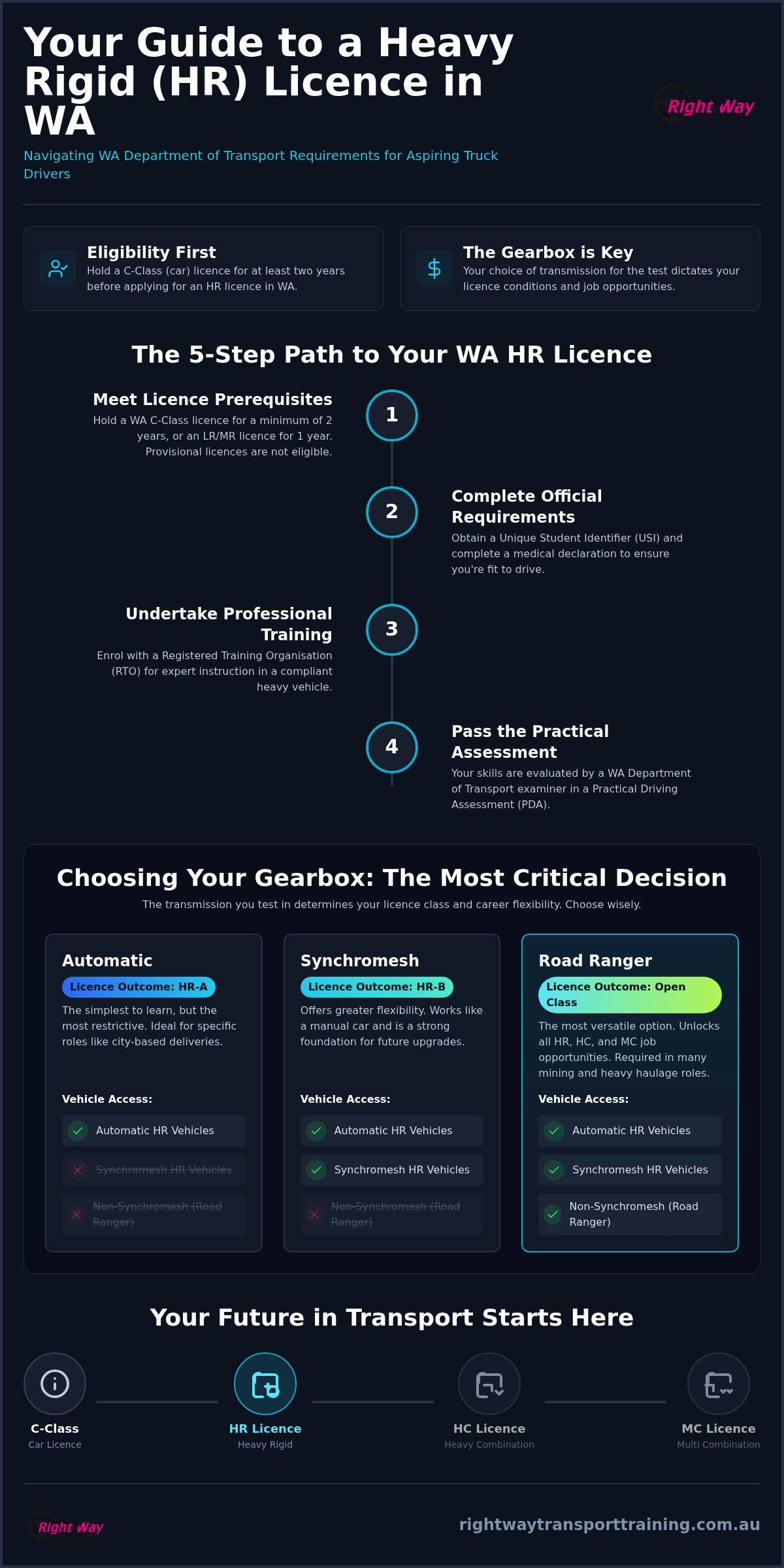
To be eligible for an HR licence in WA, you must have held a standard C-Class car licence for at least two years. If you already hold a Light Rigid (LR) or Medium Rigid (MR) licence, you only need to have held that qualification for at least one year. Provisional licence holders aren’t eligible to upgrade until they’ve reached the full licence stage. You’ll also need to complete a medical declaration to ensure you’re fit to operate a heavy vehicle safely. The HR licence is the most popular entry point for the transport industry because it offers immediate job opportunities in construction, mining, and local freight without the added complexity of towing multiple trailers.
Department of Transport WA Compliance
It’s important to understand the relationship between a Registered Training Organisation (RTO) and the Department of Transport. Right Way Transport Training is a professional RTO; we provide the expert instruction and the compliant vehicle, but the DoT remains the final licensing authority. Before you begin your heavy rigid driving lessons, you must have a Unique Student Identifier (USI). This is a federal requirement for all vocational training in Australia. Once your training is complete, your Practical Driving Assessment (PDA) is booked and conducted by a DoT examiner who will evaluate your technical skills and safety awareness on Perth roads.
Choosing the Right Gearbox: Automatic vs Synchromesh vs Road Ranger
The gearbox you select for your heavy rigid driving lessons is perhaps the most critical decision you’ll make before starting your training. In Western Australia, the Department of Transport categorises licences based on the transmission used during your practical assessment. This choice doesn’t just affect how you drive during your test; it dictates which vehicles you can legally operate for the rest of your career. While modern fleets are shifting toward automated transmissions, the WA transport landscape remains diverse, requiring a strategic approach to your training to ensure you remain employable across all sectors.
Industry demand in Perth varies significantly depending on the type of work you’re targeting. Local delivery companies often prefer the simplicity of automatics, while heavy-duty mining and civil construction firms often require drivers who can handle manual systems. Balancing the difficulty of the learning curve with your long-term career flexibility is essential. Choosing a more challenging gearbox now can prevent the need for costly re-training and re-assessments in the future.
Synchromesh (Condition B) vs Automatic (Condition A)
A Condition A licence is restricted to automatic vehicles. This is becoming common for urban delivery and waste management fleets where ease of use is a priority. If you choose a synchromesh gearbox, you’ll earn a Condition B licence. This functions much like a manual car, where the gearbox synchronises the speed of the gears for you. Holding a Condition B licence allows you to drive both automatic and synchromesh trucks, providing significantly more flexibility. It’s a vital stepping stone for those planning to upgrade to Heavy Combination (HC) or Multi Combination (MC) licences later, as it builds a stronger foundation of engine control and gear selection.
The “Open” Licence: Mastering the Road Ranger
The non-synchromesh gearbox, commonly known as the Road Ranger, is the pinnacle of heavy vehicle operation. Unlike other transmissions, it requires a technique called “double-clutching” to match the engine speed with the road speed. While the learning curve is steeper and can be frustrating for beginners, an “Open” licence is still the gold standard in the WA transport industry, particularly for line-haul and mining work. The National Heavy Vehicle Regulator establishes safety and technical standards that are best met by drivers who truly understand their vehicle’s mechanical limits. Mastering the Road Ranger rhythm takes patience, but it ensures you’ll never be turned away from a job because of a licence restriction. You can view our gearbox-specific training options to see which path aligns with your professional goals.
What to Expect During Your Heavy Rigid Driving Lessons
Your first session of heavy rigid driving lessons marks a major shift in how you perceive the road. You aren’t just driving a larger car; you’re operating a heavy machine that requires a methodical approach to safety and control. A typical lesson is structured to mirror the real-world demands of the transport industry, beginning with a thorough vehicle inspection and ending with a secure shut-down procedure. Our instructors focus on building your confidence through repetitive, purposeful practice that aligns with Western Australian Department of Transport standards.
The core of your training revolves around “The Big Three”: steering, braking, and gear selection. Steering a vehicle with three axles requires you to account for a much wider turning circle and significant rear-end swing. Braking is equally different, as you must learn to manage the momentum of a vehicle weighing over 8,000 kg using air systems rather than standard hydraulics. Developing situational awareness is the final piece of the puzzle. You’ll learn to constantly scan your environment to manage the large blind spots, or “no-zones,” that exist around the cabin and the rear of the truck.
Mastering slow-speed manoeuvres is often the most challenging part of the curriculum. You’ll spend considerable time reversing into tight bays and navigating simulated industrial centres. These exercises are designed to sharpen your spatial awareness and ensure you can position the vehicle precisely without compromising safety or hitting infrastructure.
The Pre-Start and Cabin Drill
Every lesson begins with the WA DoT approved pre-start safety check. You’ll learn to inspect tyres, fluid levels, and lights while looking for any signs of mechanical fatigue. Once inside the cab, the focus shifts to the cabin drill. This involves adjusting your mirrors and seating to minimise blind spots and ensure all controls are within easy reach. A critical component of this stage is the air pressure check. You must understand how the dual-circuit braking system functions and how to verify that the vehicle has sufficient pressure to operate safely before you even release the park brake.
On-Road Skills and Defensive Driving
When you head out onto Perth roads, you’ll immediately deal with “off-tracking.” This occurs when the rear wheels follow a shorter path than the front wheels during a turn, requiring you to “set up” early for every intersection. You’ll also practice defensive driving techniques, such as maintaining appropriate following distances and using exhaust brakes or retarders effectively on descents. These tools help manage your speed without overheating the service brakes. For those just starting out, you can Learn to drive a heavy rigid truck with our beginner tips to get a head start on these essential skills.
Preparing for the WA Practical Driving Assessment (PDA)
The Practical Driving Assessment (PDA) is the final hurdle between you and your HR licence. After completing your heavy rigid driving lessons, you’ll face a Department of Transport WA examiner who will watch every move you make. They aren’t just looking at whether you can move the truck; they’re evaluating your “system of vehicle control.” This is a logical sequence of actions, course, mirrors, signal, braking, gear, and acceleration, that ensures you’re always in command of the vehicle. Assessors in Perth look for a driver who is calm, methodical, and safe.
Assessors pay close attention to mirror checks and signal timing. In a heavy vehicle, your mirrors are your lifeblood. You must demonstrate that you’re constantly aware of your surroundings, especially before changing lanes or turning. Signals must be activated early enough to warn other Perth road users of your intentions, but not so early that they become confusing. If you’re hesitant or skip a check, the examiner will mark it as a lack of observation.
Managing assessment nerves is often half the battle. This is where mock assessments with your trainer become invaluable. By simulating the exact conditions of the PDA, we help you identify small habits that could lead to a fail. It’s much better to stall or miss a mirror check during a practice run than during the actual test. Professional heavy rigid driving lessons provide the structured environment needed to iron out these creases before the big day.
Critical Fail Points to Avoid
Mounting the kerb is the most common “instant fail” we see during WA assessments. Because HR trucks have a significant wheelbase, you must swing wide during left-hand turns to ensure the rear wheels clear the corner. If any part of a tyre touches the kerb, the assessment ends immediately. Other critical errors include failing to check blind spots before moving off or changing lanes, and failing to clear an intersection properly. Incorrect gear selection that leads to engine stalling or “coasting”, which is having the clutch depressed or gear in neutral for too long, will also result in a fail.
The Reversing Manoeuvre and Load Securing
The reversing component of the PDA usually involves a “left-hand reverse” into a confined space or simulated loading dock. You must show that you can control the vehicle’s pivot point while maintaining a clear view of your surroundings. Additionally, the examiner will ask questions about load restraint and vehicle dimensions. You must be able to explain how to secure a load safely and know the height and width of your vehicle to avoid low bridges. For a deeper dive into these requirements, check our ultimate guide to the HR truck licence for more details.
If you’re feeling unsure about your technical skills, you can book a pre-assessment brush-up session with our experienced trainers to ensure you’re fully prepared for the DoT examiner.
Starting Your Transport Career with Right Way Transport Training
Completing your heavy rigid driving lessons is more than just a box-ticking exercise for a new licence. It’s the beginning of a professional journey in an industry that keeps Western Australia moving. Employers in Perth’s competitive transport sector look for more than just a plastic card; they want drivers who demonstrate a high level of technical competence and a safety-first mindset. By training with a Registered Training Organisation (RTO), you show prospective employers that you’ve met rigorous national standards and possess the practical skills required for immediate work.
Our instructors don’t just teach you how to pass a test. They use their years of experience in the transport industry to prepare you for the actual challenges you’ll face on the job. Whether you’re navigating a busy construction site in Joondalup or managing a delivery schedule through the Perth CBD, the habits you form during your initial training will define your professional reputation. Once you’ve mastered the HR class and gained some experience on the road, we can also assist with your transition to Heavy Combination (HC) and Multi Combination (MC) licences, which are essential for high-capacity freight and mining roles.
Beyond the Licence: Career Opportunities in WA
The demand for qualified HR drivers remains strong across Perth’s construction and logistics sectors. An HR licence is also a vital foundation for anyone looking to enter the mining industry, where heavy rigid vehicles are used extensively for site support and haulage. Many companies prefer “road-ready” drivers who can handle a vehicle confidently from day one. Choosing a thorough training program over a “quick-fix” licence gives you a distinct advantage. It means you can walk into a job interview knowing you have the skills to operate safely and efficiently, reducing the need for costly on-the-job re-training.
Why Train with Right Way Transport Training?
We’re committed to full compliance with the Western Australian Department of Transport regulations. Our trainers are industry veterans who have spent thousands of hours behind the wheel of heavy vehicles, and they bring that real-world knowledge to every lesson. We pride ourselves on creating a supportive, patient environment where students can build their confidence at a steady pace. We understand that moving from a car to a truck is a big step, and we’re here to act as your mentors throughout the process. When you’re ready to start, booking your first block of heavy rigid driving lessons is a simple process that sets your new career in motion.
Take the Next Step in Your Transport Journey
Securing your qualification is about more than just passing a test; it’s about building a foundation of safety and technical skill that will serve you throughout your career. You now have a clear understanding of the Western Australian Department of Transport requirements and how your choice of gearbox influences your future job prospects. Whether you’re aiming for an automatic urban delivery role or the challenge of an open class road ranger licence in the mining sector, the quality of your initial instruction is what sets you apart from the competition.
Our instructors bring decades of real-world industry experience to every session, ensuring you’re learning from mentors who know exactly what WA assessors expect. We provide WA Department of Transport compliant training and are specialists in HR, HC, and MC licence upgrades. Investing in professional heavy rigid driving lessons ensures you approach your practical assessment with the confidence and competence needed to succeed on your first attempt.
Ready to get behind the wheel? Book your HR driving lessons with Right Way Transport Training today and start your career with the right skills. We look forward to helping you reach your professional goals on the road.
Frequently Asked Questions
How many heavy rigid driving lessons will I need to pass?
The number of heavy rigid driving lessons you’ll need depends on your previous driving experience and the type of gearbox you choose to master. Most students require between five and ten hours of professional instruction to become proficient in vehicle control and WA Department of Transport requirements. Learning a Road Ranger gearbox typically takes longer than an automatic or synchromesh transmission due to the technical nature of double-clutching and matching engine speeds.
What is the difference between a Synchromesh and a Road Ranger licence in WA?
A Synchromesh gearbox uses internal synchronisers to match gear speeds, similar to a manual car, resulting in a Condition B licence restriction. In contrast, a Road Ranger is a non-synchromesh gearbox that requires the driver to manually match engine and road speeds through a technique called double-clutching. Successfully completing your assessment in a Road Ranger vehicle grants you an “Open” licence, allowing you to drive any heavy rigid vehicle regardless of its transmission type.
Can I learn to drive an HR truck if I only have an automatic car licence?
You can certainly learn to drive an HR truck if you currently hold an automatic-only C-Class licence. The Western Australian Department of Transport requires that you have held your car licence for at least two years before you are eligible to upgrade to a Heavy Rigid qualification. Your choice of truck gearbox during your heavy rigid driving lessons will determine whether your new licence is restricted to automatic vehicles or allows for manual operation.
What happens if I fail my Practical Driving Assessment (PDA)?
If you fail your Practical Driving Assessment, you’ll need to re-book a new session with the Department of Transport and pay the applicable re-assessment fee. While there’s no mandatory waiting period between attempts in Western Australia, it’s highly recommended to take additional lessons to address the specific errors identified by the examiner. Your trainer will review the assessment feedback with you to ensure you’re fully prepared for your next attempt at the PDA.
Do I need to do a theory test for an HR licence in Western Australia?
Yes, you must successfully complete a heavy vehicle theory test at a Department of Transport centre before you can sit your Practical Driving Assessment. This test covers specific regulations, safety protocols, and technical knowledge relevant to heavy vehicles. Many students choose to complete this test early in their training process to ensure they understand the legal requirements of operating a vehicle with three or more axles and a GVM over 8,000 kg.
How much does an HR licence cost in Perth including lessons and DoT fees?
The total cost of obtaining an HR licence in Perth includes Department of Transport application fees, PDA booking fees, and the cost of professional training. While DoT fees are set by the government and are subject to change, training costs vary based on the number of heavy rigid driving lessons required and the gearbox type selected. It’s best to check the current Department of Transport WA website for official licensing fees and contact your RTO for a tailored training quote.
Can I drive a bus with a Heavy Rigid licence?
An HR licence permits you to drive a bus that has three or more axles and a GVM over 8,000 kg. However, if you intend to carry passengers for hire or reward in Western Australia, you’ll also need to apply for an “F” (omnibus) or “T” (taxi/charter) extension on your licence. The HR qualification covers the technical operation of the heavy vehicle, while the extension addresses the specific safety responsibilities of public transport operators.
Is there a waiting list for truck assessments at the Department of Transport?
Waiting times for heavy vehicle Practical Driving Assessments at Department of Transport centres in Perth can vary significantly throughout the year. Demand is often high at metropolitan centres, sometimes resulting in a wait of several weeks for an available slot. We recommend checking the DoT’s online booking system regularly or speaking with your RTO, as they can often help coordinate training blocks to align with available assessment dates and ensure you are test-ready.