What if the difference between a stagnant job and a high-demand career path was just a few days of specialised training? Stepping into the cab of an hr truck for the first time is a significant milestone, yet many aspiring drivers feel held back by technical jargon and shifting regulations. You might be worried about whether a Synchromesh or a Roadranger gearbox is the right choice for your future, or perhaps the thought of the practical assessment feels a bit daunting.
It’s completely normal to feel a bit of pressure when you’re looking to level up your professional skills. We know you want to make an informed decision that offers the best return on your investment, especially with 2026 seeing shifts like the 3 per cent increase in heavy vehicle registration charges. This guide provides total clarity on the national requirements for 2026. You’ll learn exactly how to manage the licensing process, understand the impact of different gearbox restrictions on your job prospects, and gain the confidence you need to book your training with certainty.
Key Takeaways
- Identify the specific requirements for an hr truck, including the three-axle configuration and the 8,000kg Gross Vehicle Mass threshold.
- Decipher the differences between Automatic, Synchromesh, and Roadranger gearboxes to determine which licence type offers the best return for your transport career.
- Confirm your eligibility by meeting the national requirement of holding a C-class licence for two years and passing the mandatory medical fitness standards.
- Prepare for your practical assessment by understanding the essential steps of pre-start vehicle inspections and heavy vehicle cabin drills.
- Learn why a mentor-led training approach builds the confidence and real-world skills needed to thrive in the transport industry beyond the initial test.
What is an HR Truck? Defining the Heavy Rigid Licence
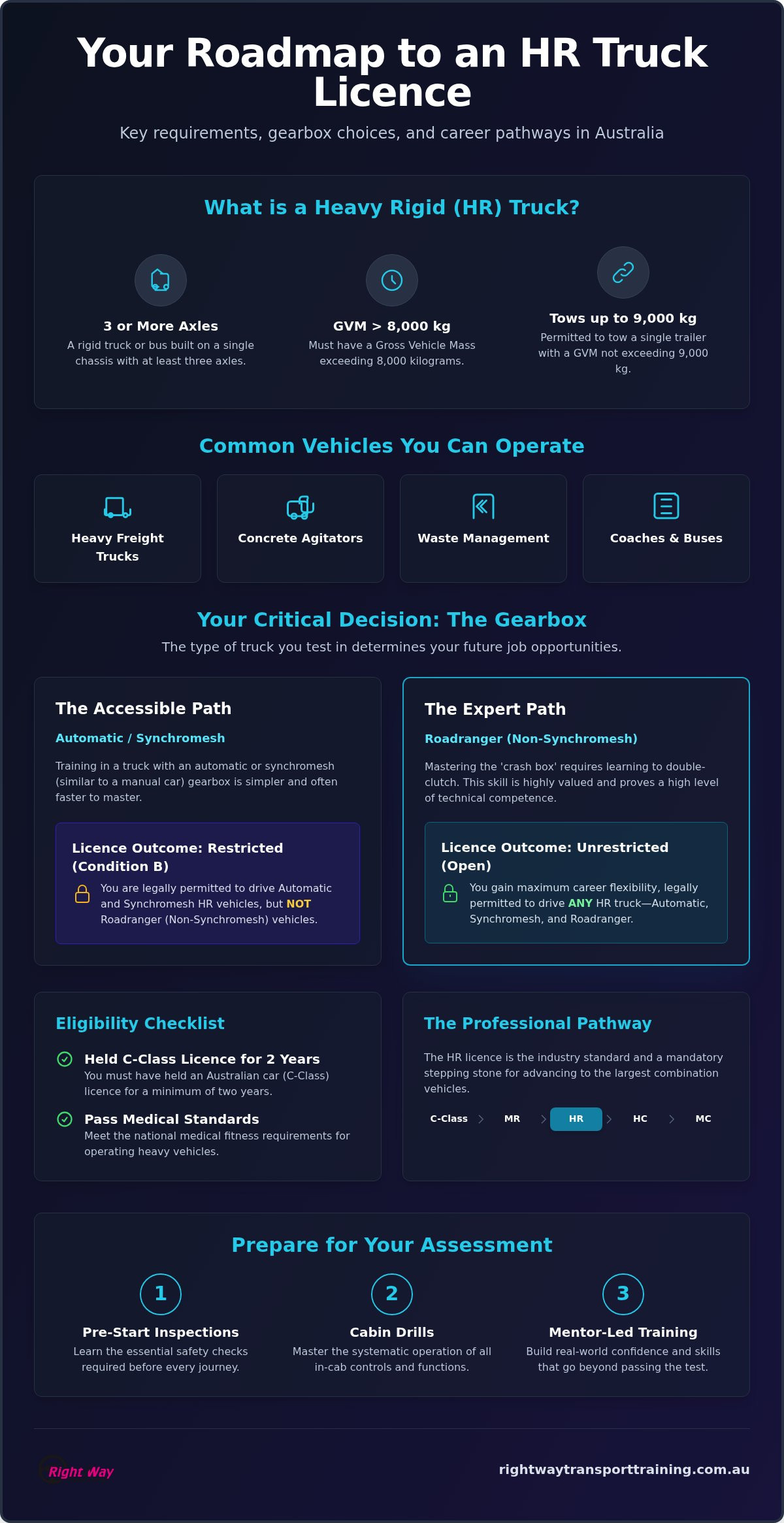
An hr truck is the backbone of the Australian logistics and civil construction sectors. To put it simply, a Heavy Rigid (HR) vehicle is a rigid truck or bus that has three or more axles. This distinguishes it from smaller, medium-rigid trucks that only have two axles. The primary technical requirement for this class is a Gross Vehicle Mass (GVM) of more than 8,000kg. While these vehicles are quite large, they are classified as “rigid” because the power unit and the load-carrying area are built onto a single, fixed chassis. It’s also useful to know that an HR licence allows you to tow a single trailer, provided that trailer does not exceed a GVM of 9,000kg. Understanding how this fits into the broader Australian driver’s licence classes is a great first step for anyone looking to build a long-term career. It sits above the Medium Rigid (MR) class and serves as the final prerequisite before you can move into “combination” vehicles like the Heavy Combination (HC) class.
Common Vehicles You Can Drive with an HR Licence
The variety of vehicles you can operate with this qualification is quite broad. You’ll frequently see these trucks handling heavy freight deliveries in urban centres where larger semi-trailers can’t easily manoeuvre. Beyond standard freight, an HR licence is essential for operating specialised machinery like concrete agitators and large waste management trucks. These roles require the stability and weight-bearing capacity that only a three-axle vehicle provides. If you’re interested in the passenger transport sector, this licence also covers large coaches and articulated buses, which are the high-capacity “bendy buses” used in major public transport networks across the country.
Why the HR Licence is the Industry Standard
If you’re browsing job boards for transport roles, you’ll quickly notice that most entry-level positions specifically ask for an HR qualification. It’s considered the industry standard because it demonstrates you have the skill to manage a high-capacity vehicle in diverse environments, from tight suburban streets to open highways. This licence offers a high level of versatility, allowing you to work in local distribution or take on interstate line-haul roles. Perhaps most importantly, the HR licence is a mandatory stepping stone for your professional growth. You generally can’t jump straight into the biggest rigs on the road. Mastering an hr truck is the best way to gain the foundational experience and confidence you need before eventually upgrading to HC or Multi Combination (MC) licences.
Understanding Gearbox Types: Synchromesh vs. Roadranger
When you start training in an hr truck, the most important decision you’ll make isn’t the colour of the cab, but the type of transmission under the floor. There are three main gearbox categories in the heavy vehicle world: Automatic, Synchromesh, and Non-Synchromesh, which is commonly known as the Roadranger. An unrestricted or open licence is a qualification that allows you to drive any heavy rigid vehicle regardless of its transmission type, and it can only be obtained by passing your practical assessment in a non-synchromesh vehicle. If you choose to take your test in a truck with an automatic or synchromesh gearbox, your licence will carry a “Condition B” restriction. This means you are legally permitted to drive both automatic and synchromesh trucks, but you’re restricted from operating anything with a Roadranger box.
The mechanical difference between these systems is significant. A synchromesh gearbox works much like a manual car, using internal synchronisers to match the speed of the gears before they engage. In contrast, a Roadranger is a “crash box” that lacks these helpers. It requires the driver to manually match the engine speed to the road speed through a technique called double-clutching. Mastering this skill is often seen as a rite of passage. To ensure you meet the necessary standards for either path, it’s vital to review the official national HR Licence eligibility and requirements before booking your course.
The Roadranger (Non-Synchromesh) Challenge
Learning to drive a Roadranger requires patience and a good ear for the engine. You have to depress the clutch once to neutral, match the revs, and then depress it again to engage the next gear. While it sounds complex, this robust technology is still the preferred choice for heavy-duty fleet vehicles because of its durability under extreme loads. Holding an unrestricted licence carries a certain level of prestige in the industry. It proves you have a high level of technical competence and gives you the flexibility to jump into any vehicle a boss throws at you without worrying about licence conditions.
Choosing the Right Gearbox for Your Career
Your choice should align with where you want to work. Modern urban delivery fleets are rapidly moving toward automatic transmissions to help with driver fatigue in stop-start traffic. If you plan on doing local supermarket runs or general freight in the city, a Condition B licence is often more than enough. However, the mining and heavy haulage sectors still lean heavily on the reliability of non-synchromesh boxes. If your goal is to eventually move into big rigs in the outback, starting with an unrestricted hr truck qualification is a smart move. Enrolling in professional heavy rigid driving lessons that cover all transmission types early on can save you from having to pay for a restriction removal later in your career. You might find that investing in comprehensive training early on saves you from having to pay for a restriction removal later in your career.
HR Licence Eligibility and National Requirements
Getting behind the wheel of an hr truck requires more than just a desire to drive big rigs. In most Australian states, the foundational requirement is that you must have held a Class C (car) licence for at least two years. This ensures you have enough road experience to handle the increased responsibility of a heavy vehicle. Generally, the minimum age to apply is 19 years old. You’ll also need to meet commercial medical fitness standards. This isn’t just a quick check; it’s a formal assessment by a doctor to ensure you don’t have underlying conditions that could impair your safety on the road. A standard eye-sight test is also mandatory at the start of your application process to confirm you can clearly see road signs and hazards from a distance.
The Licensing Pathway: HVCBA vs. Practical Driving Test
There are two main ways to gain your qualification across Australia. The Heavy Vehicle Competency Based Assessment (HVCBA) is a popular model where you work with a Registered Training Organisation. This pathway allows you to learn and be assessed by a qualified trainer who acts as a mentor throughout the process. You’ll often be assessed in the same vehicle you’ve used for training, which helps reduce those pre-test nerves. Alternatively, you can opt for a standard practical driving test conducted by a government examiner. While both lead to the same licence, many drivers prefer the HVCBA route because it prioritises consistent performance and real-world skill over a single “pass or fail” session in a high-pressure environment.
Essential Theory: The Heavy Vehicle Knowledge Test
Before you even touch the steering wheel of an hr truck, you must pass the Heavy Vehicle Knowledge Test. This theory exam isn’t just a formality; it covers critical safety topics that keep you and other road users safe. You’ll be tested on several key areas:
- Fatigue management and legal driving hours to prevent accidents.
- Correct load restraint techniques to ensure cargo doesn’t shift during transit.
- The physics of heavy vehicles, specifically focusing on air brake systems and significantly longer braking distances.
- General road rules as they apply to larger, heavier vehicles.
It’s best to study the official Heavy Vehicle Driver Handbook thoroughly before your test. We always recommend using online mock tests to practice until you’re consistently getting a perfect score. This builds your confidence and ensures you understand the complex regulations before you head to the service centre for the real assessment.
What to Expect During Your HR Truck Training
Transitioning from the theory test to the driver’s seat of an hr truck is where your professional journey truly begins. Your practical training is structured to build your confidence through a logical progression of skills, moving from basic controls to complex road scenarios. It’s a hands-on process designed to ensure you’re comfortable with the size and weight of the vehicle before you ever head into heavy traffic. If you want a detailed breakdown of the techniques involved, our beginner’s guide to learning to drive a heavy rigid truck covers every stage of the process in depth.
- Step 1: You’ll start with pre-start vehicle inspections and cabin drills. This involves checking vital fluids, tyres, and lights while ensuring your seat and mirrors are perfectly positioned for maximum visibility.
- Step 2: You’ll move on to mastering gear changes and smooth acceleration. Even in an automatic or synchromesh vehicle, managing the momentum of a heavy rigid vehicle requires a steady, deliberate touch.
- Step 3: Low-speed manoeuvres come next. You’ll spend time in a controlled environment practicing reversing and bay parking until these movements become second nature.
- Step 4: You’ll then head onto public roads to manage vehicle dimensions in live traffic. Navigating intersections and tight corners requires a completely different line of sight than a standard car.
- Step 5: The final stage is your competency assessment. This covers all the practical skills you’ve developed to ensure you’re ready to operate safely as a professional.
Mastering Heavy Vehicle Manoeuvres
Reversing into a loading dock is often the part of the course that makes students feel a bit anxious. It’s a technical exercise that requires patience and precise mirror use to manage the significant blind spots inherent in a large vehicle. You’ll also spend time on the ‘braking to a stop’ exercise. This isn’t just about hitting the pedal; it’s about understanding how air brakes respond differently than hydraulic car brakes. Learning to feather the brakes ensures smooth, controlled stops that are essential for both cargo safety and passenger comfort.
Road Craft and Defensive Driving
Professional driving is as much about your mindset as it is about your hands on the wheel. We teach the ‘look ahead’ principle, which involves scanning the road 12 to 15 seconds ahead of your current position. This proactive approach gives you ample time to react to hazards, especially when you consider air brake lag. This is the slight delay between pressing the brake pedal and the brakes actually engaging. Maintaining a safe following distance is non-negotiable for any hr truck operator. Beyond the technicalities, a professional attitude and solid road etiquette will set you apart in the transport industry. If you’re ready to get started, you can book your HR truck training today and begin your journey with mentors who care about your long-term success.
Launch Your Transport Career with Right Way Transport Training
Right Way Transport Training stands as the premier choice for individuals who want to develop industry-ready skills and long-term career stability. We don’t just teach you how to pass a government assessment; we prepare you for the daily realities and challenges of the Australian transport sector. Our mentor-led approach is specifically designed to reduce the anxiety many beginner drivers feel when they first climb into the cab of an hr truck. By learning from seasoned industry veterans, you gain immediate confidence and a sense of grounded reliability. We focus on safety and real-world competency, ensuring you’re ready to handle a heavy vehicle in any professional setting, from busy city depots to regional highways.
Our trainers act as partners in your professional journey rather than just distant instructors. This personal, supportive environment makes the prospect of professional advancement feel attainable and safe. We take great pride in our local community and the success of every student who passes through our doors. When you train with us, you’re joining a network of professionals who value competence and reliability above all else. This steady leadership helps you move through your training with informed certainty.
Why Professional Training Beats “Learning on the Job”
Trying to learn the ropes from an uncertified friend or colleague often leads to picking up dangerous bad habits that are hard to break. These shortcuts might seem easier at first, but they often lead to failed assessments or, worse, safety incidents on the road. Structured training significantly accelerates the learning curve, especially when you need to master the technical complexities of a Roadranger gearbox. Our students benefit from training in a modern, well-maintained vehicle fleet, which makes the transition from a standard car feel much more manageable and less intimidating. You’ll learn the correct techniques from the start, ensuring you meet the high professional standards that top-tier employers expect from an hr truck operator.
Your Pathway to HC and MC Licences
Obtaining your HR licence is the essential foundation for your entire transport career. It’s the mandatory stepping stone if you eventually want to drive the massive road trains that keep our country moving. Once you’ve mastered the rigid vehicle, the pathway to Heavy Combination (HC) and Multi Combination (MC) licences becomes much clearer and more achievable. This progression allows you to move from rigid trucks to more complex heavy combinations, opening up higher-paying roles and more varied work opportunities across the nation. We invite you to take that first step with us and transition from a car driver to a professional operator. Book your first lesson today and start your journey with a team that’s committed to your success.
Take the Wheel of Your New Career
Obtaining your heavy vehicle qualification is more than just ticking a box for a new job. It’s about gaining a professional skill set that stays with you for life. By understanding the differences between gearbox types and meeting the national eligibility requirements, you’ve already done the hard work of planning. Now it’s time to put that knowledge into practice. Whether you’re aiming for an unrestricted licence or a standard automatic qualification, mastering an hr truck opens doors to stable and rewarding work across the country.
At Right Way Transport Training, we pride ourselves on delivering nationally recognised training standards. Our expert trainers bring decades of industry experience to every lesson, offering comprehensive HR, HC, and MC courses that focus on your long-term safety. We’re here to guide you through every reversing manoeuvre and pre-start check with patience and expertise. You don’t have to navigate this transition alone.
Start your HR truck training journey with Right Way Transport Training today and join a community of skilled professionals. Your new career is just around the corner, and we’re ready to help you reach it with confidence.
Frequently Asked Questions
How long does it take to get an HR truck licence?
Most students complete their training and assessment within one to two days. This timeframe depends on your previous experience and the gearbox type you’ve chosen to master. An intensive one-day course is common for those with some heavy vehicle exposure, while a two-day course provides more time to build confidence in the cab. We ensure the pace matches your learning needs so you’re truly industry-ready.
Can I drive an HR truck on a car licence?
No, you cannot legally operate an hr truck with a standard C-class car licence. A car licence only permits you to drive vehicles with a Gross Vehicle Mass (GVM) of up to 4,500kg. Since a heavy rigid vehicle exceeds 8,000kg and features three or more axles, you must successfully complete the specific training and assessment to obtain the correct licence class.
What is the difference between an HR and an HC licence?
The primary difference is the vehicle configuration and what you’re allowed to tow. An HR licence is for rigid vehicles where the load-carrying area is fixed to the chassis. A Heavy Combination (HC) licence allows you to drive articulated vehicles, such as a prime mover towing a semi-trailer. Obtaining your HR is often the best first step before moving into these larger combination rigs.
Is it hard to learn to drive a Roadranger gearbox?
Learning a Roadranger gearbox is a technical challenge that requires patience, but it’s far from impossible with professional mentoring. It involves mastering double-clutching and matching engine revs to your road speed. While it feels different from a car at first, most students find the rhythm becomes second nature after a few hours of focused practice in a supportive environment.
Do I need to do a medical test for an HR licence?
Yes, you must meet commercial medical fitness standards to operate heavy vehicles in Australia. This involves a formal examination by a doctor to confirm you don’t have health conditions that could impact road safety. It’s a standard part of the application process and ensures that all professional drivers on our roads are fit for the demands of the job.
What jobs can I get with an HR licence in the transport industry?
This qualification opens doors to diverse roles in urban logistics, civil construction, and public transport. You could find yourself driving concrete agitators, waste management trucks, or large passenger coaches. Many companies also require hr truck drivers for local freight distribution, making it one of the most versatile and in-demand licences for those starting a new career path.
Can I upgrade from an MR to an HR licence immediately?
You can typically upgrade to an HR licence if you’ve held a Medium Rigid (MR) or Light Rigid (LR) licence for at least 12 months. If you’re upgrading directly from a C-class car licence, the national standard usually requires you to have held that licence for at least two years. This ensures you have the foundational road craft needed for heavier vehicles.
What happens if I fail my HR practical assessment?
If you don’t pass your practical assessment, you don’t need to start from scratch. You can book a re-sit after doing some extra practice to polish the specific skills that needs improvement. Our trainers provide clear, constructive feedback so you know exactly what to focus on. We’re here to support you until you feel confident and ready to pass with flying colours.